
Shell Drop, audited with Claude Mythos 5.2 through Anthropic’s cyber defence access
Shell Drop 5.2.7 was audited with Claude Mythos 5.2, through Anthropic’s cyber defence access, after a broad first pass with Claude Fable 5.2 the same day. Neither audit found a way to take a password or a private key from the app, and the core design held up. What they did turn up was fixed and re-tested, and all of it is in 5.2.7, on the App Store now.
An SSH app holds the keys to the servers people run their work on, so it is the kind of app that should be audited with the strongest tools available.
What held up
- Passwords and private keys. They live only in this device’s Keychain and never sync to iCloud. Neither audit found a working way to take one.
- The SSH connection. The connection itself and the way Shell Drop checks a server’s host key both read as sound.
- Face ID. The protection on keys and on key forwarding held.
- Privacy. The app still collects no data, and nothing in it listens on the network.
The first audit, from June, came to the same view of the design, and the security and privacy page keeps the current picture.
What Mythos 5.2 did
Mythos gave Shell Drop an independent second opinion. It audited the app blind, before it saw anything from the first pass, and worked the way an attacker would: start from what someone would want to take, then try to get to it.
It went past reading the code. Mythos built its own automated test tool and ran about 970 tests against the app while it carried on reading. What it turned up was fixed the same day, and 600 more test runs on the finished build came back with zero failures.
The Fable 5.2 first pass
Earlier that day Claude Fable 5.2 ran a wide sweep with Cloudflare’s open-source security-audit skill. It came to 110 agent runs: 26 hunting agents working through the code in four waves, three coverage critics looking for anything left unchecked, and two separate verifiers testing every lead before it counted. It confirmed nothing critical or high. What it logged was mostly low, the kind of tidy-up a wide sweep is good at, and it was dealt with the same day.
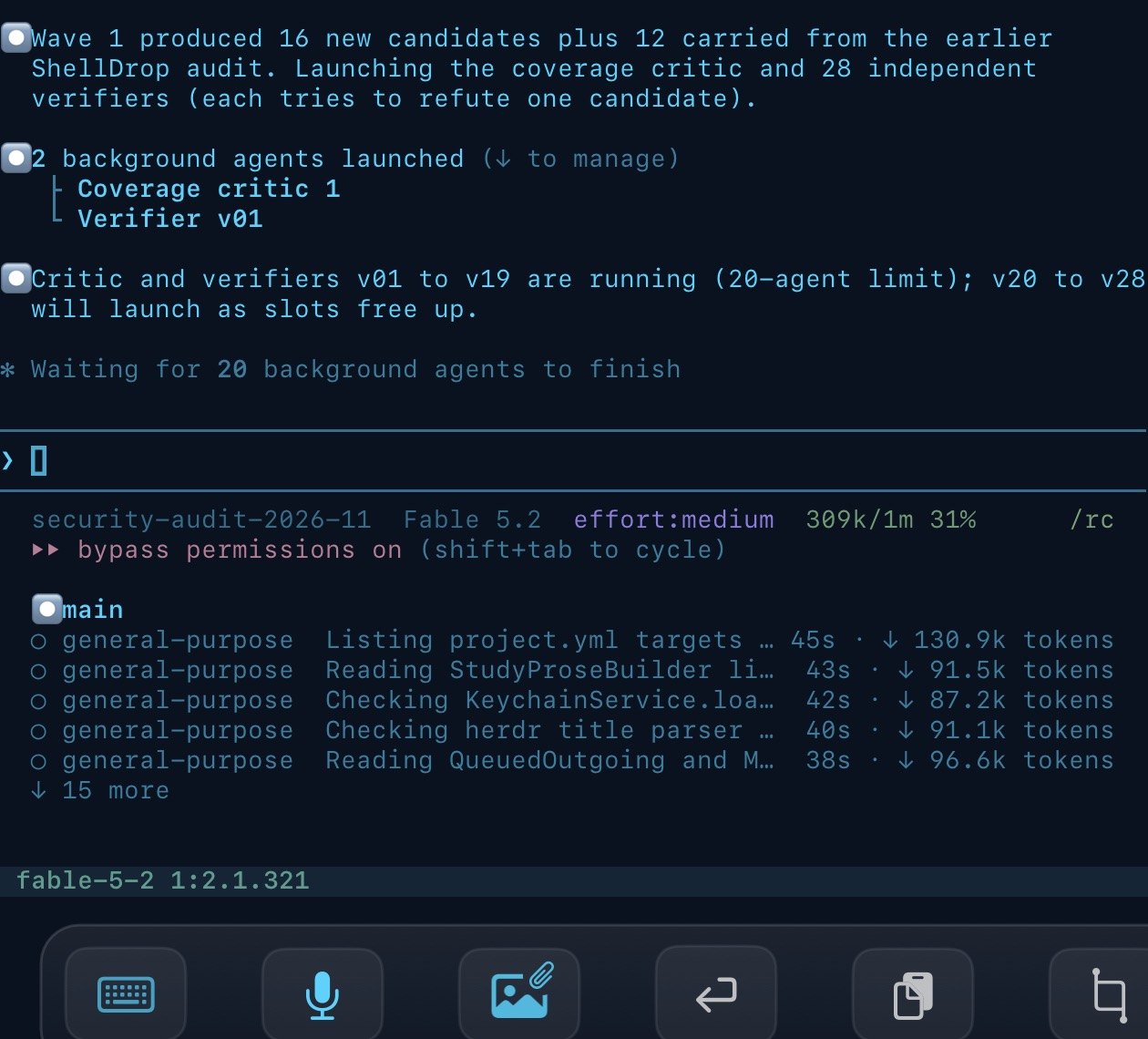
The two audits did different jobs. Fable covered a lot of ground quickly, and Mythos went deep, testing the app as well as reading it.
Tighter in 5.2.7
The audits led to a round of tightening. These are the changes you might notice:
- Saved sign-ins stay with their server. If a connection synced from another device points somewhere new, Shell Drop asks you to sign in again.
- Private key export always asks for Face ID.
- Key forwarding ends with the connection. “Allow for this connection” on SSH agent forwarding ends when you disconnect.
- Siri asks you to unlock first before it lists your connections.
- Uploads get random names and never overwrite an existing file.
- Stricter limits on images a server sends to the screen.
Also in 5.2.7: Herdr
5.2.7 is also the first version of Shell Drop to support Herdr, the open-source terminal workspace manager built for AI coding agents. Herdr does the job Tmux does, keeping agents running on the server when the phone disconnects, and adds a state for every pane: working, blocked or idle.
- Nothing to set up. Shell Drop spots Herdr by itself, and Herdr turns on mouse scrolling and names the window for you.
- Tabs named after workspaces. A tab takes its Herdr workspace name and follows it when you switch or rename.
- Straight back in. After a dropped connection or a relaunch, Shell Drop goes back into the Herdr session the tab was in.
- Agent needs you, in every pane. The live activity follows every agent in the Herdr session, across every pane and workspace.
The Herdr on iPhone page covers setup and how Herdr compares with Tmux. The options are in Settings > Terminal > Herdr.
Shell Drop 5.2.7 is on the App Store now. Shell Drop is free for iPhone, iPad and iPhone Duo, iOS 17+.
Next, in 5.2.8: the Mythos 5.2 efficiency rebuild.